Red Balloon Stunt: Making Web3 SDK Tangible
Making MetaMask SDK Tangible

Overview
Role: Senior UX Researcher
Team: Product/Stunts, Design, Marketing, DevRel, Engineering
Timeline: Q3 2024
Product: MetaMask Delegation Toolkit
The Problem
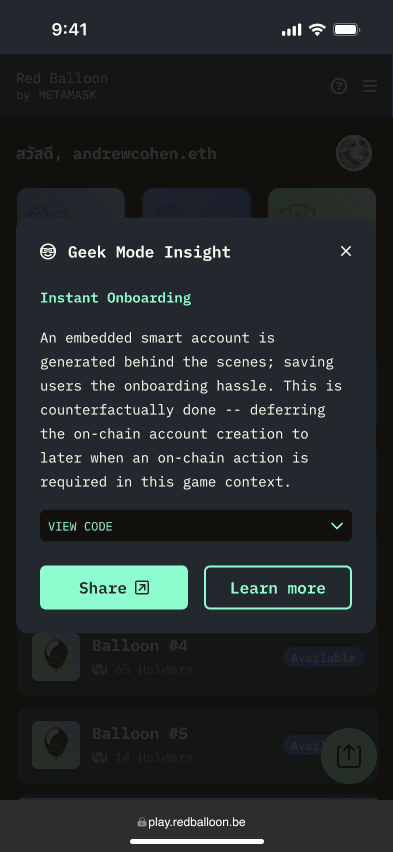
How do you explain "gasless UX" and "incentive trees" to a stadium full of developers who are already drowning in technical pitches? At ETHCC Brussels, we wanted people to feel and see what the MetaMask Delegation Toolkit could do: instant onboarding, trustless agreements, complex incentive structures, without a single slide presentation.
Our hypothesis: hide balloons across the venue and city with real ETH prizes attached, and let the hunt itself teach the mechanics of delegation.
My Approach
I led the research effort across three phases (scoping and planning, live execution, and synthesis) using a mix of on-the-ground observation, contextual and targeted interviews, and social listening.
During the three-day event, I tracked how players actually moved through the venues, where they got stuck, and how they organized themselves. I caught winners and key participants right after their "aha" moments to capture feedback while it was still raw, ran deeper interviews with specific segments to understand how they interpreted "commissioning," the delegation concept at the game's core, and monitored public chatter to see how perception and understanding of the technology shifted in real time.

What Worked
People self-organized. The physical, IRL nature of the hunt created instant community: strangers teaming up, sharing tips, forming temporary alliances. It proved that social, in-person mechanics are a real lever for Web3 adoption, not just a gimmick.
The prize did its job. 5 ETH got people curious enough to show up and start playing.
The concept landed physically. Turning "delegation" into something you negotiate with another human, face to face, made an abstract crypto primitive suddenly make sense.
What I Learned
Some of the most valuable insights were the friction:
Competition cut both ways. Negotiating commission rates felt tense for a lot of players, and that tension crowded out the fun. Takeaway: reward collective participation, not just winners, to avoid a zero-sum feel.
The story didn't always land. Some players had fun without ever connecting the dots back to the actual product. The "reveal" needed more scaffolding: teasers, context, something to bridge the game to the tech.
Coordination was harder than expected. Both online and on the street, players wanted more structure, clearer rules or hints, without losing the thrill of the hunt.
Why It Mattered
This project became a case study in something I care about: research is about a looping back into the product. The insights here directly shaped follow-up recommendations: rewarding all participants, building lighter-weight onboarding cues, and treating go-to-market and research as one connected process instead of two separate tracks.