Simplifying Crypto through P2P Interactions
Driving Adoption Through Intuitive P2P Interactions & Gift Card Flows

Overview
Role: Senior UX Researcher
Team: Product Design, Engineering, Product Management
Timeline: Q1–Q2 2024 (two studies)
Product: MetaMask Crypto Gift Card
The Problem
How do you get people to trust crypto enough to bring their friends in? Web3's growth depends on network effects, but two things kept getting in the way: the fear of losing money, and the sheer complexity of the experience.
We ran two parallel bets to fix this. Could existing users be turned into onboarding guides for newcomers? And could a gift card make receiving crypto feel as simple and delightful as receiving a gift card for anything else?
My Approach
I ran two research streams consequently, with one study informing the next.
For peer to peer onboarding, I interviewed "Activators" — experienced users who'd already helped someone else onboard in the past year — in 45–60 minute sessions. I wanted their full arc: why they got into crypto, who and why they chose to help, and what almost went wrong along the way.
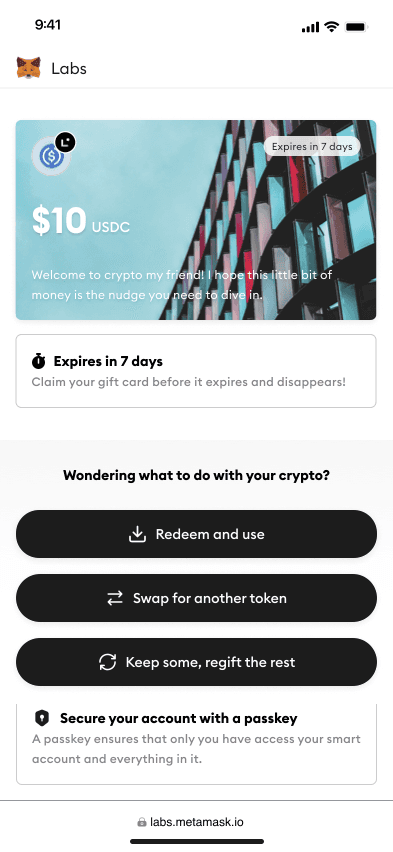
For the the crypto gift card flow, I synthesized phase 1 findings I ran short, 30-minute think-aloud usability sessions on high-fidelity Figma prototypes, split between returning Senders (those who would send the card) and crypto-naive Receivers. I was also testing emotional reactions to specific decisions, like who pays gas fees, and whether receiving an NFT feels different than receiving tokens.

What Worked
Money talked louder than mission. Activators name-checked Web3 ethos (e.g. decentralization), but what actually drove them was financial upside and protecting friends from costly mistakes. That reframed our team's messaging from "join the revolution" to "seize this opportunity."
Hands-on beat hands-off, every time. Onboarding succeeded when it was personal: in person, or in a trusted group chat. Generic guides didn't stand a chance.
Sponsoring gas fees changed the emotional temperature. When senders covered a receiver's gas cost, recipients reacted noticeably more warmly and were more willing to actually use the flow.
What I Learned
Trust and friction turned out to be the same problem wearing two faces. People didn't abandon these flows because crypto was confusing in the abstract, they abandoned them at the exact moment a fee, a security prompt, or an unfamiliar format introduced doubt. Fixing that moment mattered more than any amount of visual polish.
I also learned how much power there was in translating an emotional signal — a participant's fear of causing a friend's financial loss — into something concrete and testable. That translation, from feeling to hypothesis to requirement, is where I felt most useful in the room.
Why It Mattered
This work was about de-risking two speculative bets before more engineering time went in. By staying close to design through rapid Figma iterations, I made sure decisions were built on observed behavior, not assumptions about what users would want.
The findings reshaped the roadmap directly: mitigating gas fee friction and reinforcing security messaging became non-negotiable priorities for both the P2P onboarding flows and the Gift Card feature, and meaningfully improved the odds of a successful launch.